Case Study
From Campaign Brief to Approved Assets Without Losing the Thread
How a structured kickoff, persistent project context, and specialized writing modules helped a marketing team move from raw inputs to final messaging across three stages of work.
Where most AI workflows break
Not on first draft speed. On continuity.
The team needed to move from campaign planning to message development to final reusable assets. Each stage required different thinking. Kickoff needed clarity. Strategy needed focus. Writing needed discipline. Review needed memory. The risk was familiar: every new step could wipe out the logic of the last one.
The process
Three modules, one chain of logic
Project Kickoff
Locked the brief, audience, constraints, and workflow order. Created persistent project context.
Messaging Matrix Builder
Identified strongest message territory, audience fit, and source-backed proof. Filtered out weak directions.
FAQ Writer
Expanded the approved strategy into question-led answers using a Jobs-to-be-Done framework.
Step one
How kickoff changed the project
Kickoff did more than gather background. It created operating structure. The team locked the project objective, audience, message focus, deliverable types, timeline, and constraints. It also set the order of work.
- Persistent project brief—available across all later modules without re-explaining the assignment
- Eliminated re-briefing—every module session started with the approved context already loaded
- Changed how review worked—from “is this good?” to “does this match the approved brief?”
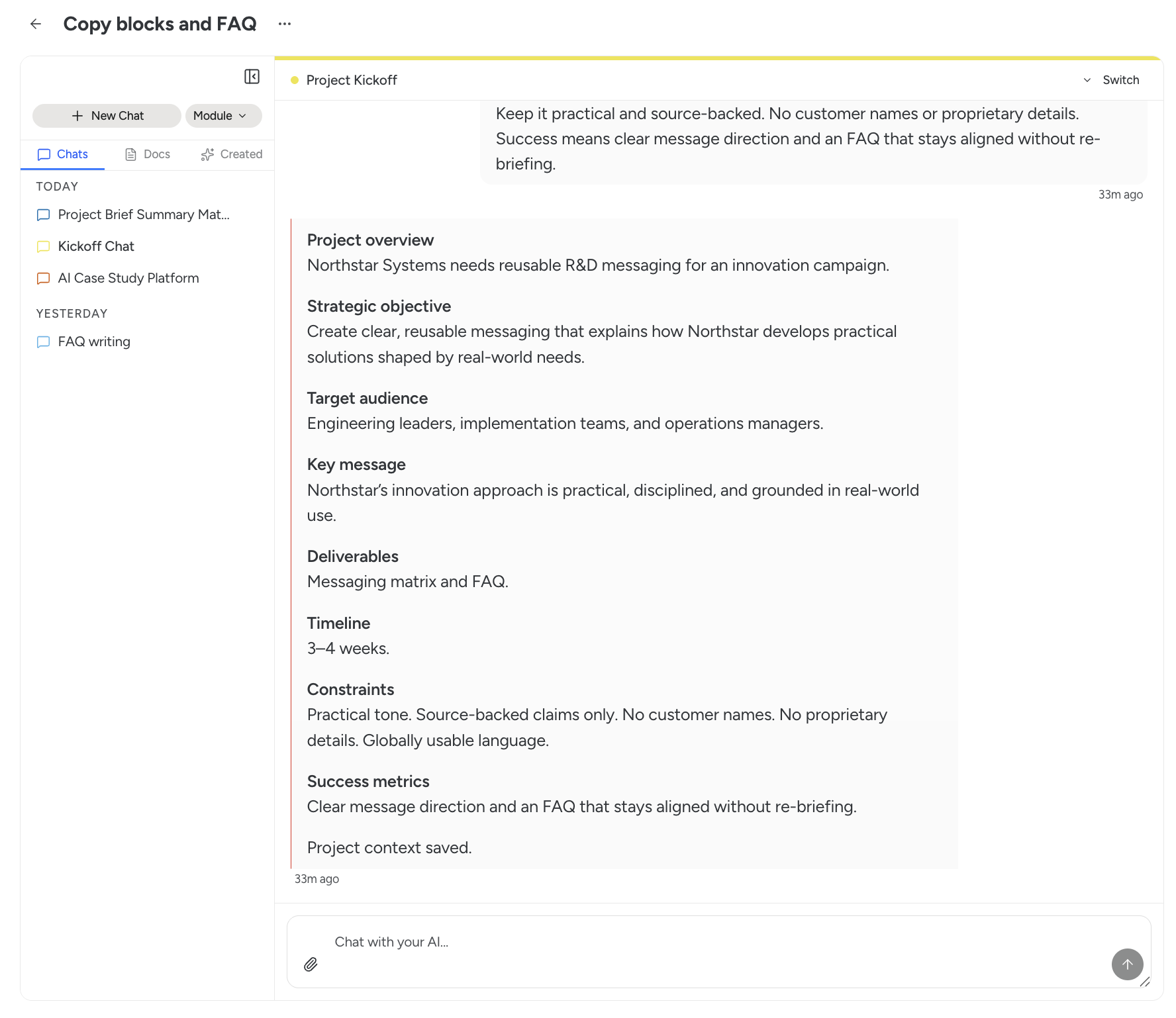
The Project Brief output. View full screenshot →
Step two
The strategic hinge
The messaging matrix took the rough source base and forced sharper choices. It identified the strongest message territory, the clearest audience fit, and the best proof to support the story. It also ruled out weaker directions before they spread into later drafts.
- Core recommendation
- Master message
- Message angles
- Source-backed proof set
- Guardrails for what to include and what to avoid
By the end of this step, the team had a clear direction, a defined audience priority, a narrowed proof base, and a shared standard for evaluating later drafts.
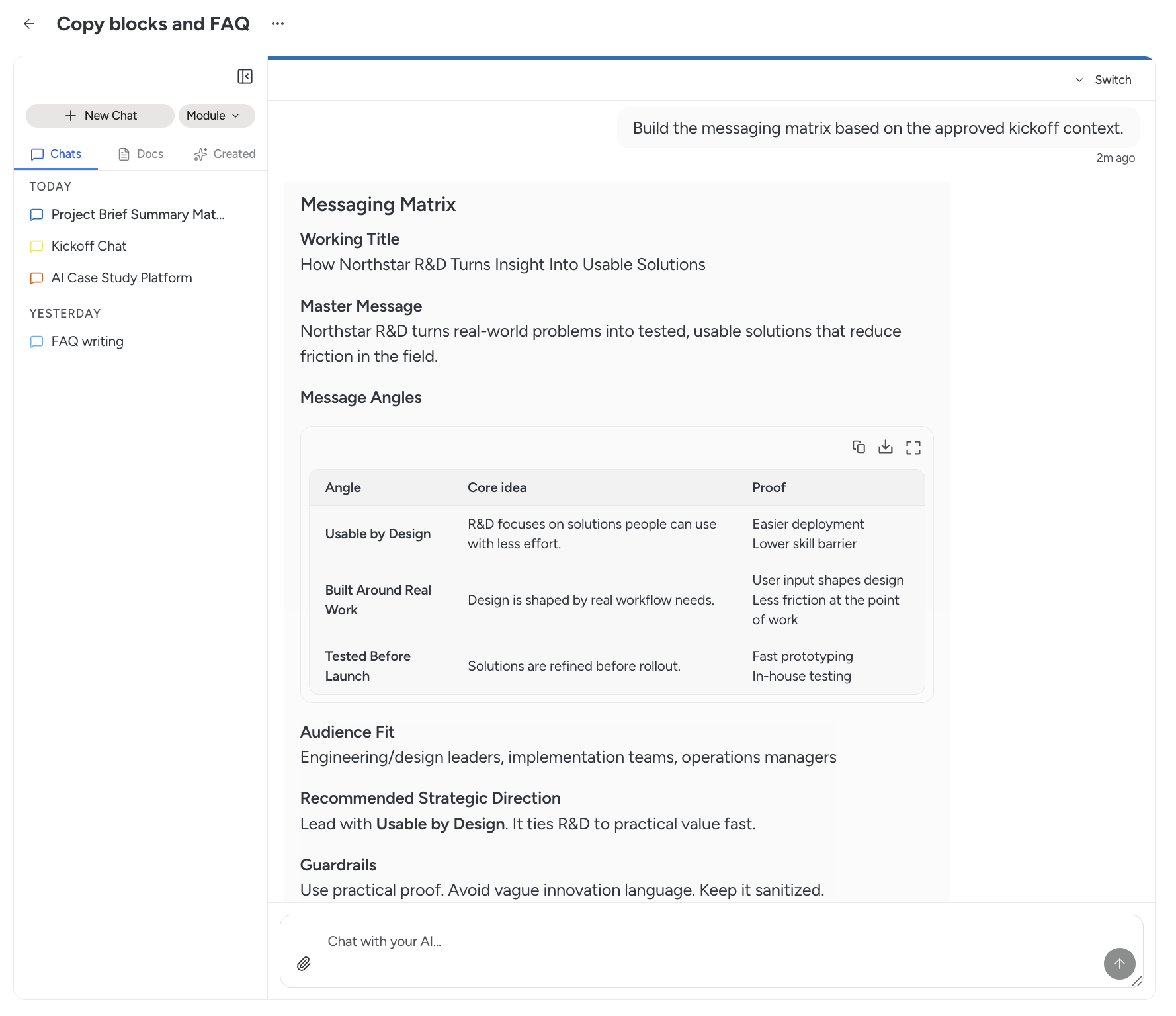
The messaging matrix output. View full screenshot →
Step three
Where continuity proved its value
Before drafting began, the team made a framework decision: the FAQ should follow a Jobs-to-be-Done structure. Instead of organizing questions around product categories or internal talking points, the FAQ was organized around the audience’s practical needs.
- Turned strategy into utility—the FAQ showed how the message answered practical questions
- Improved consistency—the same proof points carried into a new asset type without dilution
- Specialized tool for a specialized job—FAQ writing requires question design, answer discipline, and a strong organizing frame
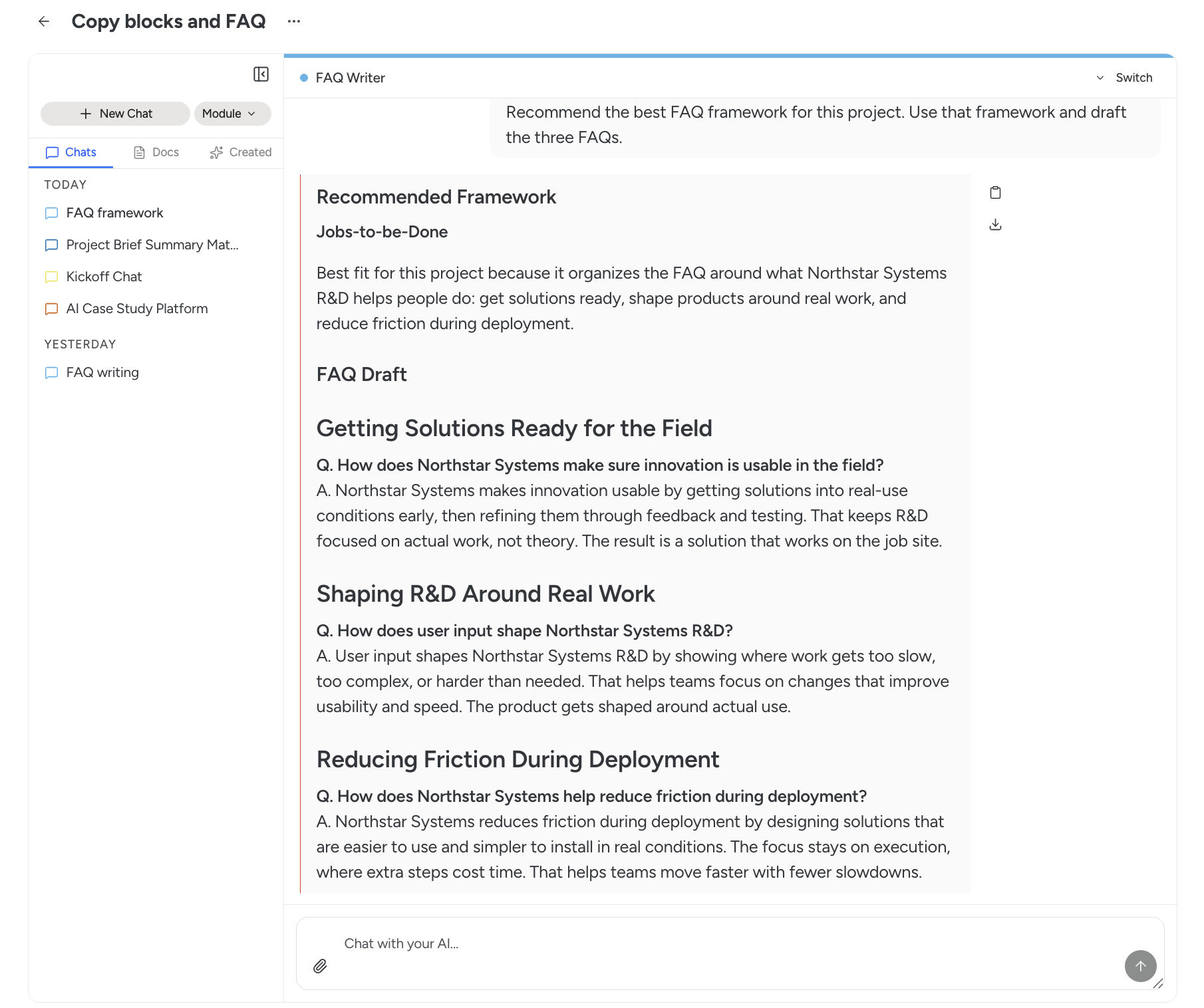
The FAQ writer output. View full screenshot →
Why the module-by-module approach worked
The strongest part of this workflow was separation with continuity. Each module had a defined role. None had to do all the thinking at once. Kickoff set the frame. The messaging matrix chose the story. The FAQ writer turned that strategy into practical, audience-facing content. At every step, approved decisions carried forward.
Operational benefits
Less rework
Locked decisions carried forward. Later modules did not reopen settled ground.
Better alignment
Outputs stayed tied to audience, core message, and approved proof.
Cleaner handoffs
Each module inherited project context and latest decisions.
Stronger governance
Record of what was approved, what changed, and what was final.
Faster revision
Feedback focused on the draft, not re-litigating the brief.
Reusable output
Connected parts of the same messaging system, not isolated pieces.